Tech Support: (888) 792-7106 Sales & Marketing: (833) 998-7229
Clients treated with Trac9 achieved 82% greater symptom
improvement compared to those treated without Trac9
(23.80 vs 13.08 GRS points, p < 0.001).
Clients treated with Trac9 have a 6.6 percentage point absolute risk reduction in one-year post-discharge substance use compared to clients treated without Trac9. (Relapse risks: 50.2% untreated, 42.1% treated without Trac9, 35.5% treated with Trac9)

The Trac9 Top Therapists Awards were created to honor and recognize the top therapists across the country. 3rd Quarter Finalists and Winners announced November 1, 2025.
Facilities using Trac9 average 80.1% successful treatment completion compared to national average of 64.5%.
Dive into expert Insights and updates directly from the Trac9 team. Gain our Insights along with case studies, our latest innovations, industry trends, and the science driving our solutions.
Experience Dr. Dempsey’s expert insights on mental health, addiction, and treatment innovation at top conferences and events. Don’t miss the chance to learn from a leading voice in the field.
Enhancing Treatment Effectiveness & Clinical Outcomes
Clients not completing treatment have an extreme risk for relapse. Trac9 facilities have an average successful completion rate of 80.1% (client does not leave AMA or is asked to leave) vs national average of 64.5%. Trac9’s facility-specific predictive algorithm identifies clients most at risk of leaving against medical advice and notifies clinical staff for immediate intervention. Trac9’s algorithm identifies at-risk clients, helping to prevent them from leaving Against Medical Advice.
Patients receiving treatment with Trac9 achieved 82% greater GRS improvement compared to those treated without Trac9 (23.80 vs 13.08 GRS points, p < 0.001).
Each week Trac9 assesses the combination of pathology (symptom) and resilience factors most predictive of sustained recovery.
We call the aggregate score of these factors the Trac9 Global Recovery Score (GRS).
Trac9 is associated with a 6.6 percentage point absolute risk reduction in one-year post-discharge substance use compared to standard treatment without Trac9.
(Relapse risks: 50.2% untreated, 42.1% treated without Trac9, 35.5% treated with Trac9).
Trac9 assesses the combination of factors most predictive of relapse risk to inform treatment.
Total Clinical Quality™ (TCQ) is a framework for optimizing a provider’s care delivery system. Rather than viewing outcomes as the result of one clinician or one intervention, TCQ recognizes that clinical excellence emerges from how people, processes, and technology work together across the organization to deliver care.
How is TCQ different from Measurement-Based Care (MBC)?
Measurement-Based Care (MBC) is a clinical practice method focused on tracking client symptoms to guide treatment decisions. Total Clinical Quality™ (TCQ) is a full-system performance framework that uses MBC as just one component to drive measurable, system-wide clinical excellence. If MBC is “doing good therapy better,” TCQ is “building a clinically excellent organization.”
How does Trac9 enable Total Clinical Quality™?
Trac9 goes beyond traditional measurement-based care (MBC) to help providers optimize their care delivery system. Designed by clinical psychologists, Trac9 empowers clinicians, supervisors, clinical directors, and CEOs with real-time data to understand what’s happening, intervene early, and continuously elevate quality.
Trac9 is your Therapeutic Co-pilot™. Leveraging over 7.5 million completed assessments, Trac9 has unmatched power to predict both clients leaving treatment early (AMA) and post discharge relapse risk. Trac9’s multi-factor assessment battery and advanced analytics provide superior ability to detect progress issues early, provide clinical insights, and provide clinical suggestions.
Trac9 was built for behavioral health / mental health based on science, and has been proven in use with thousands of therapists, to significantly improve client outcomes beyond treatment-as-usual.
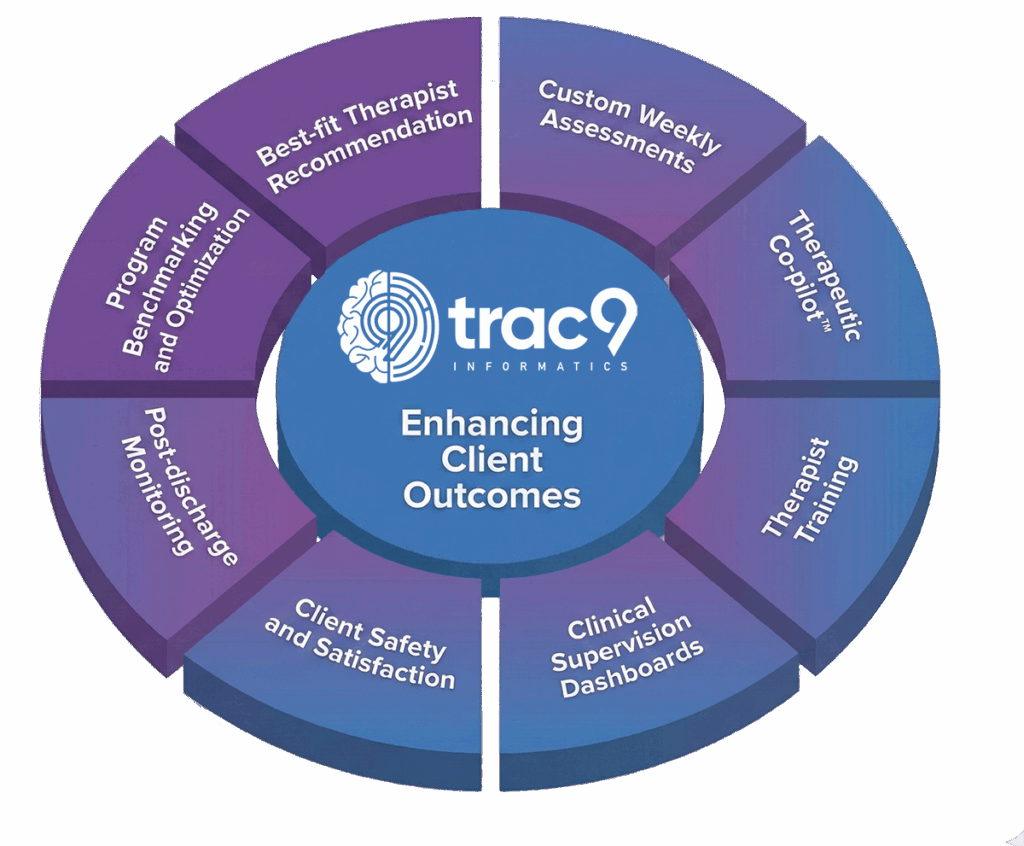
Custom Weekly Assessment Battery
Trac9 measures the combination of pathology and resilience factors shown to be most predictive of sustained recovery. Its weekly assessment battery is customized to the client’s specific diagnosis and co-occurring conditions ensuring the most clinically relevant insights.
Therapeutic Co-pilot™
Trac9 analyzes the results of each weekly assessment battery and provides alerts, clinical insights, and clinical suggestions and treatment guides:
URGENT: Client# 1234 has been flagged by the Trac9 algorithm as high risk for leaving treatment Against Medical Advice (AMA). See the Intervention Guide for suggested AMA blocking steps.
Predictive Relapse Risk – Trac9 predicts the client’s risk of relapse within one year if they were to leave treatment at that point in time provides targeted clinical suggestions to help reduce that risk.
Warning: Relapse Risk is HIGH (52%) as of 02/19/2025 Suggestion to reduce relapse risk from 52% to 20%: Implement stress reduction interventions such as diaphragmatic breathing, progressive muscle relaxation, or guided imagery. Recommend adding aerobic exercise into their daily routine.
Treatment Progress – Trac9 alerts clinicians when a client’s progress on any factor falls below what is associated with successful treatment and provides clinical suggestions and treatment guides to help get progress back on track.
Warning: Client’s depression score exceeds the clinical threshold for week 3 of treatment. Memory Specificity Training may be considered to help the client improve specific autobiographical memory recall, reducing rumination and over-general thinking that maintain depressive symptoms. See Treatment Guide
Factor Correlations – Trac9 detects when two factors are moving together and identifies opportunities to leverage improvement in one factor to accelerate progress in the other.
Warning: Verbal craving is increasing and optimism is decreasing. This pattern is associated with treatment failure. Improving optimism will likely result in decreased cravings.
Advanced Clinical Interpretations – Trac9 identifies clinically meaningful relationships between multiple factors, providing deeper insights for targeted clinical exploration.
Client may be experiencing depression in the context of difficulty adapting to current stressors, with relatively low anxiety. Explore practical barriers to adaptation, recent stressors, and coping resources, as this pattern can reflect demoralization or overwhelm rather than worry driven distress.
Because most therapists have not been trained in measurement-based care, Trac9 includes robust training and ongoing support. Quarterly training sessions—led by one of our psychologists—teach clinicians how to interpret measure levels, trends, and relationships between factors. Trac9 also offers “office hours” for consultations. The Therapeutic Co-pilot™ includes downloadable treatment guides and training materials.
Clinical Supervision Dashboards
Client outcomes are aggregated by clinician to quantify clinician outcomes, highlighting both strengths and opportunities for development. Weekly assessment completion and review metrics are also displayed to support accountability and continuous quality improvement.
Client Safety and Satisfaction Surveys
Customizable Client Safety and Satisfaction surveys are available and can be administered automatically as part of the weekly assessment battery or administered on demand.
Post-discharge Monitoring
Follow-up surveys are sent by email and text message each month for 12 months after discharge to monitor long-term outcomes. Responses are anonymous, and incentives can be offered to increase response rates.
Program Benchmarking and Optimization
Outcome data is aggregated at the facility level and benchmarked against national averages to identify patterns of strengths and improvement opportunities. These insights drive program-optimization recommendations. We meet with your leadership team quarterly to review results and provide practical suggestions to accelerate improvement.
Trac9 Certified Metrics
Trac9 provides certified outcomes metrics for your facility / program which can be used for marketing and payer negotiations.
SUD/MH/Dual
Full Continuum of Care:
• Detox
• Residential
• IOP/PHP
• Private Practice
Populations Include:
• Commercial
• Medicaid
• Veteran
• Court Ordered
• Weekly Progress Monitoring
• Co-occurring Conditions
• Client Satisfaction
• Post-Discharge Outcomes


The Trac9 Top Therapists Awards were created to honor and recognize the top therapists across the country. These professionals are truly best-in-class healthcare providers, embodying excellence in clinical care.
This recognition reflects the commitment to excellence in therapy and the high standards each of our partner facilities uphold on a daily basis. We congratulate these therapists for their remarkable achievements and are proud to work with such dedicated professionals.
The Trac9 Top Therapist Award Winners for Q3 of 2025 are:
And we are thrilled to honor the 2024 Trac9 Top Therapist Award Winners for the full year:
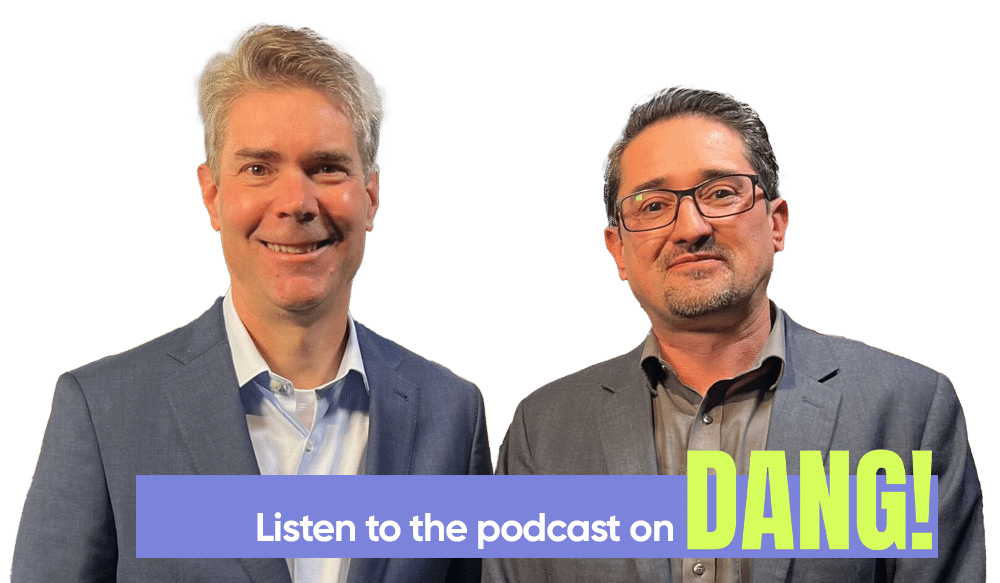
with Jared P. Dempsey, Ph.D. & Kevin Jones
As heard on the DANG! podcast: “If recovery had a GPS, these guys from Trac9 built it.”
“The trust that people place in us when they enter treatment motivates us to provide the gold standard of care and innovate. This means that we have to adapt and utilize new treatment methods and tools to help our patients start a new life in recovery. One of those tools is Trac9! We’re very excited about the doors Trac9 will open for us in improving our care even further and embracing our mission to its fullest!”
Ashley Treatment Centers