

Why Measurement-Based Care Often Falls Short and What It Takes to Make It Work
By Kevin R. Jones, CEO, Trac9 Informatics, July 22, 2026
Click here to download the complete PDF of this Trac9 Insight
Measurement-based care (MBC) has become one of the most widely endorsed evidence-based practices in behavioral health. A substantial body of research demonstrates that routinely measuring patient progress and using that information to guide treatment can improve outcomes, particularly for patients who are not responding as expected. Perhaps more importantly, studies by Michael Lambert and colleagues have shown that, without systematic outcome monitoring, clinicians fail to recognize approximately 70–90% of patients who are deteriorating during treatment. In other words, even experienced clinicians often need objective feedback to identify patients whose treatment trajectory is quietly going off course.
As a result, measurement-based care is increasingly being incorporated into clinical guidelines, accreditation standards, and value-based care initiatives. ASAM emphasizes ongoing multidimensional reassessment throughout treatment and the Joint Commission requires organizations to use standardized outcome measures to evaluate treatment effectiveness.
Yet despite broad consensus on its importance, many organizations struggle to realize the clinical benefits that measurement-based care promises. Too often, assessments become an administrative exercise rather than a clinical one. Patients complete questionnaires that are never discussed during therapy. Clinicians receive scores but little guidance on what they mean or how to respond. Data are collected inconsistently across programs, limiting confidence in reported outcomes. Dashboards are built for executives while frontline clinicians lack timely, actionable information. In these situations, organizations are measuring outcomes without systematically improving them.
The challenge is designing clinical systems that reliably transform measurement into better decisions, better treatment, and ultimately better patient outcomes. That requires more than selecting assessment instruments or implementing new software. It requires workflows, clinician engagement, supervision, organizational accountability, and technology that work together to ensure patient feedback influences care at every level of the organization.
The following implementation challenges consistently emerge across behavioral health organizations. They are not unique to any one measurement platform or provider, but rather represent the practical barriers that must be addressed if measurement-based
care is to achieve its full clinical potential. Throughout the discussion, our experience from working with over 200 Substance Use Disorder, Behavioral Health, and Mental Health treatment programs to implement measurement-based care is used to provide examples of how these challenges can be addressed.
The Checkbox Problem: Data is Collected but Not Used
Perhaps the most common failure mode in measurement-based care is what many clinicians informally refer to as “checkbox implementation.”
Patients are asked to complete questionnaires because an accreditor, payer or organizational initiative requires them. The resulting scores may be stored in the EHR, but they are not used to inform treatment. This is equivalent to a physician ordering blood tests but then not reviewing the results before adjusting the patient’s medications. In medicine, this would be considered malpractice.
The evidence supporting measurement-based care shows that improved outcomes occur when clinicians review assessment results, discuss them collaboratively with patients, and modify treatment when progress stalls. Collecting questionnaires without acting on them adds administrative burden without producing clinical benefit and leads to resistance to continuing to do work that is not used.
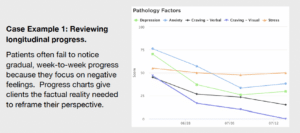
High-performing organizations design workflows that make assessment results part of every clinical encounter. Clinicians review trends before or during the session, patients participate in interpreting their own progress, and significant changes trigger additional clinical review or modifications to the treatment plan. Measurement becomes part of the therapeutic conversation rather than a documentation exercise.
This is where technology can play an important role. Rather than functioning just as an assessment library, modern measurement-based care platforms are increasingly designed to organize longitudinal trends, identify clinically significant concerns, and present information in ways that support decision-making during treatment. Trac9 is one example of this approach. The platform presents longitudinal changes across multiple recovery domains, highlights potential issues, and provides structured treatment recommendations intended to support, not replace, clinical judgment. The objective is not simply to record patient-reported outcomes, but to ensure those outcomes influence care while treatment is still underway.
Measurement-Based Care Is a Change-Management Initiative
Another common misconception is that measurement-based care can be implemented simply by selecting assessment instruments and purchasing software.
Successful implementation requires meaningful changes in clinical workflow, supervision, training, and organizational culture. Clinicians need confidence not only in the measures themselves but also in how to interpret results, discuss findings collaboratively with patients, and adjust when patients are not progressing as expected.
Concerns that standardized measures oversimplify complex patients, interfere with therapeutic relationships, or may eventually be used for performance evaluation can all reduce adoption if organizations fail to address them openly.
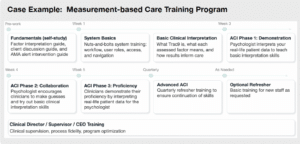
Organizations that achieve lasting success typically treat measurement-based care as a clinical quality initiative rather than an information technology project. Leadership establishes clear expectations, supervisors reinforce consistent use, clinicians receive ongoing education, and measurement becomes integrated into routine case review and clinical supervision.
Technology should enable and support these processes. Trac9, for example, combines assessment and analytics technology with clinician training, implementation support, supervisory reporting, and ongoing consultation designed to reinforce high-fidelity measurement-based care over time.
Reliable Outcomes Require Reliable Measurement
As behavioral health increasingly moves toward value-based reimbursement and public reporting of outcomes, organizations face another challenge that receives comparatively little attention: denominator integrity.
If assessments are completed inconsistently across clinicians, locations, or patient populations, reported outcomes may reflect only those patients who completed the assessments rather than the organization’s true clinical performance. Missing assessments, inconsistent follow-up, and varying clinician participation can all introduce bias that limits the usefulness of outcome data for quality improvement or payer accountability.
Organizations seeking to demonstrate measurable performance therefore need standardized assessment schedules, consistent follow-up procedures, and transparent reporting of completion rates alongside outcome measures. Reliable measurement processes are just as important as favorable outcome statistics.
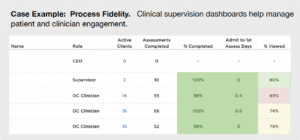
Technology can help by monitoring assessment completion, identifying missing data, and providing supervisors with visibility into adherence across clinicians and programs. Trac9, for example, incorporates standardized assessment schedules and organizational reporting that allow leaders to monitor completion rates for maintaining longitudinal patient records across the continuum of care. Regardless of the platform used, organizations should view data completeness as a quality metric in its own right.
Measuring What Matters in SUD Treatment
Selecting appropriate outcome measures presents another challenge, particularly in substance use disorder treatment.
Behavioral health has no shortage of validated assessment instruments. The difficulty is that individual measures were typically developed to evaluate specific constructs rather than recovery as a whole. Furthermore, cut scores are based on people who, for example, have no anxiety versus only have anxiety. This wouldn’t be the appropriate cut score for someone entering into residential treatment. Depression scales measure depressive symptoms. Anxiety measures assess anxiety. Neither was designed to determine whether an individual is progressing toward sustained recovery after treatment.
Recovery is inherently multidimensional. Emotional symptoms are only part of the picture. Craving, recovery commitment, quality of life in addiction recovery, resilience, optimism, social functioning, and other recovery factors all influence long-term outcomes. In addition, self-report measures may be influenced by denial, limited insight, social desirability, or temporary emotional state, particularly among patients with substance use disorders.
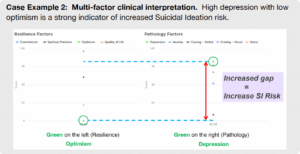
For these reasons, many organizations are moving toward multidimensional assessment models that evaluate both symptoms and recovery strengths while also identifying response patterns or inconsistencies that may warrant further exploration during treatment. These discrepancies often lead to productive clinical discussions that uncover issues patients have not yet fully recognized or disclosed.
Trac9 illustrates this approach by combining measures of anxiety, depression, stress, cravings, commitment, optimism, quality of life in addiction recovery, spirituality, along with measures for other patient-specific clinical concerns into a longitudinal recovery profile. This allows clinicians to look beyond individual scores and interpret how changes across multiple domains interact, often revealing clinically meaningful patterns that would be missed by reviewing each measure separately.
The value of measurement based care ultimately depends on whether it translates into better outcomes. In a real-world analysis of nearly 98,000 residential substance use disorder treatment episodes, higher therapist review and utilization of Trac9’s digital therapeutic features was associated with 82% greater improvement in recovery scores during treatment and a 6.6 percentage-point reduction in one-year relapse risk compared with treatment as usual with minimal Trac9 utilization. Although observational studies cannot establish causation, results of this magnitude provide strong real-world evidence that implementing measurement-based care with high fidelity can meaningfully improve patient outcomes and warrants broader adoption and prospective validation.
Evidence for Measurement Based Care Effect on Outcomes
Study Population
97,960 residential SUD treatment episodes. Primary treatment-outcome analysis included 39,106 episodes with complete Week 1–Week 4 clinical outcome data. Relapse analysis included 6,271 treatment episodes with one-year follow-up after statistical adjustment for follow-up bias.
What Was Measured
Trac9 measured nine factors throughout treatment, including: Anxiety, Depression, Stress, Verbal craving, Visual craving (cue exposure), Commitment to sobriety, Optimism, Quality of life in addiction recovery, and Spirituality. These factors were combined into a Global Recovery Scale (GRS) to measure overall clinical improvement. Most factors utilize established public-domain instruments or validated adaptations for addiction treatment. Trac9 measured 1-year post-discharge relapse (any use of alcohol or other drugs), via patient surveys administered monthly for 12 months.
Key Clinical Findings
Compared with patients receiving standard residential treatment with minimal Trac9 engagement:
- Patients receiving full therapist review and Trac9’s cue exposure achieved 82% greater symptom improvement during treatment (23.8 vs. 13.1 GRS points; p < .001).
- Estimated one-year relapse risk decreased from 42.1% to 35.5%, representing a 6.6 percentage-point absolute reduction.
- Greater therapist engagement produced progressively larger improvements from Week 2 through Week 4, suggesting cumulative benefit over the course of treatment.
- Improvement in patient functioning statistically mediated the reduction in relapse risk, indicating that better clinical outcomes, and not simply greater engagement, were associated with lower relapse rates.
Methodological Strengths
The study incorporated several features intended to strengthen confidence in the findings:
- Large real-world treatment population (nearly 98,000 episodes)
- Adjustment for baseline symptom severity
- Adjustment for treatment completion status
- Inverse probability weighting to reduce follow-up selection bias
- Bootstrap mediation analyses (5,000 replications)
- Sensitivity analyses for visual cue exposure
- Reporting of confidence intervals, effect sizes and model diagnostics
Important Considerations
Like many real-world behavioral health effectiveness studies, this was not a randomized controlled trial. The analyses demonstrate strong associations between higher Trac9 utilization and improved outcomes but cannot definitively establish causation. Although statistical methods were used to adjust for measured differences between patients, unmeasured differences may still have influenced outcomes. The authors acknowledge the potential for selection effects, particularly in follow-up participation, and used inverse probability weighting to address this limitation.
Moving From Population Reporting to Patient-Level Action
Behavioral health organizations have become increasingly sophisticated in reporting enterprise-level outcomes. Executive dashboards compare facilities, programs, and clinicians while helping organizations demonstrate accountability to boards, referral sources, and payers.
While this information is important, it should not become the end goal. The true value of measurement-based care lies in helping clinicians make better decisions for the individual patient during treatment. When that happens consistently, meaningful organizational outcomes naturally follow. Organization-wide reporting should emerge naturally from thousands of patient-level clinical decisions rather than becoming the primary objective.
High-performing organizations therefore build continuous feedback loops that connect every level of the organization: Patient measurement → clinician interpretation → treatment response → supervisory review → organizational learning.
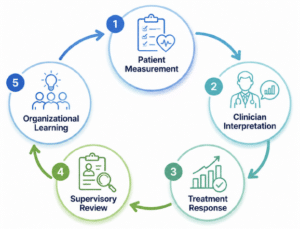
When a patient begins to stagnate or deteriorate, clinicians receive timely feedback. Supervisors identify patterns across caseloads. Leadership evaluates trends across programs. Successful interventions become standardized, while ineffective practices are revised. Measurement becomes a mechanism for continuous organizational learning rather than retrospective reporting.
Platforms such as Trac9 increasingly support this multi-level feedback model by presenting patient-specific information to clinicians while simultaneously providing supervisors and executives with aggregated quality metrics.
Reducing the Technology Integration Burden
One of the greatest risks in measurement-based care implementation is adding administrative burden without improving clinical efficiency.
Successful implementation therefore depends on workflow integration as much as technical integration.
Patients should complete assessments with minimal staff involvement. Results should be automatically scored, presented in clinically meaningful formats, incorporated into routine treatment planning, and documented efficiently within existing workflows. The technology should make high-quality care easier rather than requiring clinicians to perform additional administrative tasks.
Trac9 demonstrates one implementation approach through automated assessment delivery, real-time scoring, graphical trend analysis, clinical decision support, and streamlined integration into clinical documentation. The specific technology may differ across organizations, but the objective remains consistent: reduce administrative burden while increasing the clinical usefulness of patient feedback.
Measurement-Based Care Is Becoming a Clinical Operating Model
Behavioral health is entering a new era of accountability. Providers are increasingly expected to demonstrate measurable outcomes, payers are placing greater emphasis on value, and organizations are seeking practical ways to improve care rather than simply document it.
Organizations that consistently achieve better outcomes are beginning to treat measurement-based care as a clinical operating model rather than an assessment program. They measure consistently, review results collaboratively, respond systematically when patients are not progressing, support clinicians through ongoing training and supervision, and use aggregated data to drive continuous organizational improvement.
Technology is an important enabler of that transformation, but it is not the transformation itself. Platforms such as Trac9 illustrate how these principles can be operationalized within everyday clinical practice. The future of behavioral health will belong to organizations that build systems in which measurement routinely informs clinical judgment, organizational learning, and better patient outcomes.
References
- Lambert, M. J., Whipple, J. L., & Kleinstäuber, M. (2018) Collecting and Delivering Progress Feedback: A Meta-Analysis of Routine Outcome Monitoring.
- Lambert, M. J. (2010). Prevention of Treatment Failure: The Use of Measuring, Monitoring, and Feedback in Clinical Practice.
- Fortney, J. C., et al. (2017). A Tipping Point for Measurement-Based Care. Psychiatric Services.
- Lewis, C. C., et al. Implementation science literature on MBC adoption.
- ASAM Criteria, 4th Edition.
- The Joint Commission Behavioral Health Care Accreditation Standards.
Click here to download the complete PDF of this Trac9 Insight